
Part of the rigid-flex circuit board resource.
Bend radius
Screen the finished flex construction. Published guidance is not a qualified minimum bend radius.
Enter your requirements to begin. JavaScript is required for calculations.
What this calculator measures
The calculator multiplies the finished flexible composite thickness by a published screening ratio. It helps compare geometry while the design is still being developed. It does not calculate conductor strain in an asymmetric stack, predict a fatigue curve, or establish an accepted production limit. Use its result to prepare a mechanical discussion with the fabricator and the product reliability team.
Use the thickness of the actual flexible region
Include the copper, flexible dielectric, coverlay, and relevant adhesives that bend together. Do not enter the rigid board thickness. Do not enter only the base-film thickness from a laminate datasheet. If the construction has multiple unbonded sublayers, each can follow a different path; a single composite-thickness number may not describe the mechanical behavior adequately. Request the proposed cross-section before using a tightly constrained bend envelope.
Formula and the selected public reference
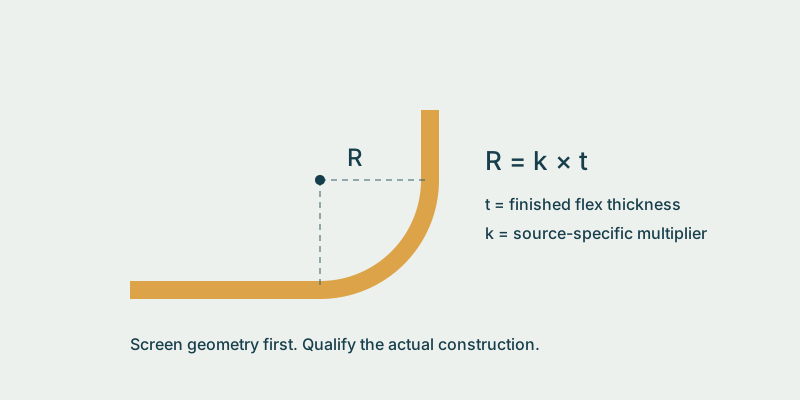
The screening relationship is R = k × t, where R is radius in millimeters, t is finished flex thickness in millimeters, and k is a dimensionless multiplier. This version uses Altium’s published design guidance: 5 for a single flex copper layer, 10 for two, and 15 for multilayer static construction. Its dynamic reference is presented as a 20–40 range, not as a validated minimum. For example, a 0.15 mm two-layer static flex gives 1.50 mm under that particular reference profile.
IPC-2223 and why the source label matters
The requested IPC-2223 coefficient profile has not been independently verified against the applicable full standard and construction. It is therefore not presented as an IPC-certified calculation. Public design articles use differing ratios and sometimes describe different materials, duty, or risk assumptions. Do not select whichever public number makes the enclosure fit. Obtain the applicable standard revision, construction-specific interpretation, and written fabricator agreement for the released design.
Static and dynamic are different requirements
Static usually means bending during installation or limited servicing. Dynamic means repeated movement during use. Frequency, travel, angle, environment, copper thickness, and strain concentration affect the second case. The dynamic range shown by this tool is an indication of one reference’s guidance, not proof that a board will survive a stated number of cycles. A test coupon must reproduce the meaningful geometry, restraints, and material system to support a useful qualification result.
How copper selection changes the conversation
The RA and ED selector adds an appropriate review warning without multiplying the result by an invented correction factor. Copper grade, treatment, grain direction, plating, and elongation data matter alongside the production method. Rolled annealed foil is often considered for repeated flexing, but it does not turn an otherwise unsuitable multilayer bend into a qualified design. Request the complete foil and stack specification when evaluating alternatives.
Carry the result into a real review
Use Send parameters for review to attach the thickness, flex-layer count, duty, and copper selection to your RFQ. Add a dimensioned sketch that identifies radius convention, bending direction, start and end positions, and the rigid edge. Include the operating conditions and the acceptance test if motion is part of normal use. The fabrication drawing should state the agreed requirement, not merely reproduce a screenshot of this calculator.
Reference and engineering context
Altium: Designing a Rigid-Flex PCB, Design Considerations. Consult the applicable IPC-2223 standard contents when identifying the standard; a contents page alone does not establish coefficients.
Related design decisions
Review the design guidelines, regional stackup guide, material-system requirements, and cost comparison guide alongside these results.
Questions about this tool
Does the result guarantee IPC compliance?
No. The tool labels a public reference profile. It has not independently verified the applicable IPC-2223 coefficient requirements.
Should I enter the rigid-board thickness?
No. Enter the finished thickness of the flexible material that bends together.
Can this predict bend life?
No. A representative mechanical test and construction-specific reliability review are required.